

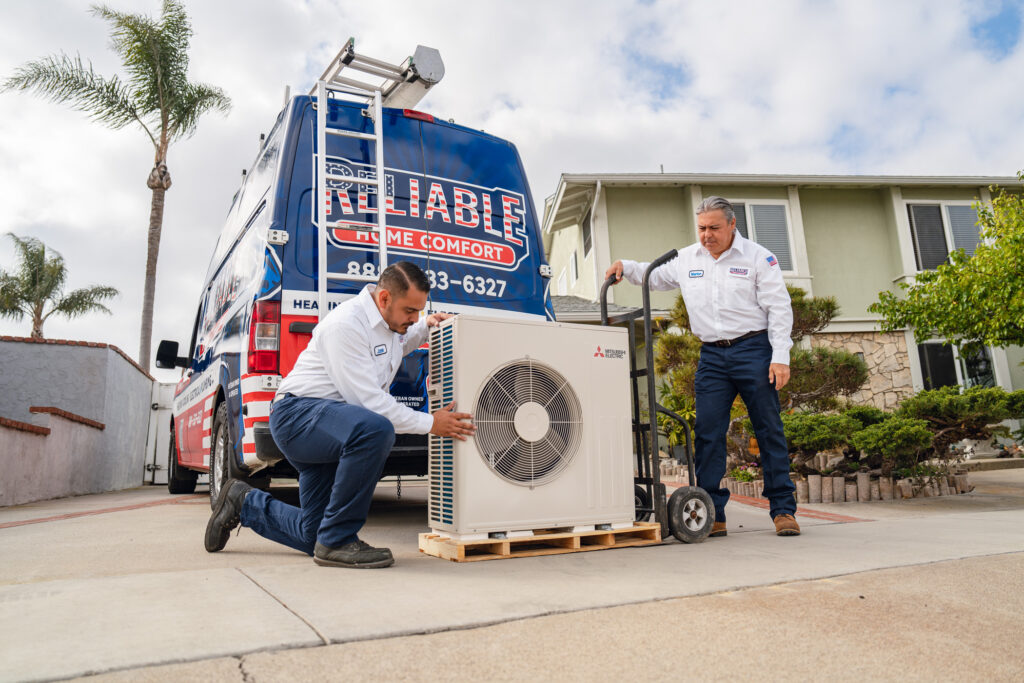
When summer heat arrives, few things are more essential than a reliable air conditioning system.
But if you are building a new home, renovating an older one, or simply replacing an aging AC unit, you are likely facing a big decision: should you choose Central Air Conditioning or Ductless Mini-Split systems?
Both types of air conditioning systems will cool your home, but they achieve that goal in fundamentally different ways.
Choosing between a mini-split or central AC depends entirely on your home’s existing infrastructure, your budget, your aesthetic preferences, and your long-term energy goals.
Of course, when it comes to your air conditioning, there is no universally “better” system. There is only the AC system that is better for your situation.
This article will help you break down the mechanics, pros, and cons of both a mini-split and central AC system to help you make an informed decision.
What’s the Difference between a Central AC and Mini-Split System?
Before diving into the comparison, it is vital to understand how these two different types of AC systems operate.
Central Air Conditioning: This is the traditional standard in most modern Los Angeles and Orange County homes. It consists of a large outdoor compressor/condenser unit and an indoor evaporator unit, usually attached to a furnace or air handler. The system cools air centrally and then uses a powerful blower fan to distribute that chilled air through a network of ducts hidden in walls, ceilings, or crawlspaces, delivering it through vents in every room.
Ductless Mini-Split: As the name implies, these AC systems require no ductwork. A mini-split air conditioner consists of an outdoor compressor linked via refrigerant lines and wiring to one or more indoor air-handling units mounted directly in the room they are meant to cool. Each indoor “head” can be controlled independently, allowing for precise temperature management in specific zones of the house.
Central AC: Your Whole-Home Workhorse
For decades, central AC has been the king of suburban comfort. Its primary appeal lies in its ability to cool an entire house uniformly while remaining relatively invisible.
Central AC Pros:
- Aesthetics: Because the mechanical components are hidden in your attic, or utility closet, and the air delivery is handled by unobtrusive vents, central AC wins on aesthetics for many homeowners. It doesn’t interrupt interior design.
- Uniformity: A properly sized and balanced central system maintains a consistent temperature throughout the entire house. You don’t walk from a cool living room into a sweltering hallway.
- Air Filtration: Because all air in the house cycles through a central handler, you can install whole-home air filtration or purification systems that treat the air in every room simultaneously.
- Cost (Sometimes): If your home already has usable, well-sealed ductwork from an existing heating system, installing central AC is often significantly cheaper upfront than retrofitting a house with multiple mini-split heads.
Central AC Cons:
- Energy Loss via Ducts: This is the biggest Achilles heel of central air. According to the Department of Energy, typical duct systems lose 25% to 40% of the cooling energy passing through them due to leaks, holes, and poor insulation in unconditioned spaces like attics.
- Lack of Zoning: Standard central AC is an “all or nothing” proposition. You cannot cool just the bedroom at night without also cooling the empty kitchen and living room, which wastes energy. (Zoning can be added to central systems with automatic dampers, but it is expensive and complex).
- Invasive Installation: If your home does not have ducts, installing them requires cutting into walls and ceilings, sacrificing closet space, and a massive amount of construction mess.
Mini-Splits: Efficient and Cost Saving Approach
Mini-splits have exploded in popularity, particularly for retrofits, additions, and energy-conscious homeowners. They offer surgical precision in cooling.
Mini-Split AC Pros:
- Superior Efficiency: Because there are no ducts, there is zero energy loss due to duct leakage. Furthermore, mini-splits use advanced inverter technology, allowing the compressor to speed up or slow down based on demand, rather than the inefficient “hard on/hard off” cycling of traditional central units.
- Zoned Comfort: This is the biggest lifestyle advantage. You can set the master bedroom to 68°F for sleeping while leaving the unused guest room at 78°F. Everyone in the house can control the temperature in their specific area.
- Quiet Operation: The indoor units are whisper-quiet—sometimes barely audible—because the noisy compressor is outside.
- Easy Installation (No Ducts): For older homes built before central heating, or for room additions like a garage conversion or sunroom, mini-splits are far easier and less destructive to install than adding ductwork.
Mini-Split AC Cons:
- Aesthetics: This is the primary barrier for many people. You must have a unit mounted on the wall (or recessed into the ceiling) in every room you want to cool. While designs have improved, they are visible appliances within the living space.
- Higher Upfront Cost for Whole Homes: While a single mini-split for one room is affordable, outfitting an entire 2,500-square-foot house with 5 or 6 indoor heads is usually more expensive upfront than replacing a central AC unit.
- Maintenance: Each indoor unit has its own filter that needs to be cleaned regularly (often monthly during high use) to maintain efficiency and prevent mold growth.
How to Decide on a Central AC vs. Mini Split
When weighing your options between and a mini-split AC system and a central air conditioning unit, consider these three crucial factors:
1. Existing Infrastructure If your home has good ductwork already in place for a furnace, the path of least resistance (and lowest cost) is usually Central AC. If you have radiators, baseboard heat, or no existing heat distribution system, the cost and mess of installing ducts make Mini-Splits the clear winner.
2. Energy Efficiency and Long-Term Costs While central AC might be cheaper to buy initially (if ducts exist), mini-splits almost always win on operating costs. Their high SEER (Seasonal Energy Efficiency Ratio) ratings and ability to zone-cool mean your monthly electric bills will likely be lower with mini-splits. If you plan to stay in the home for many years, the energy savings of a mini-split system may eventually offset its higher installation cost.
3. Home Layout and Usage Do you live in a sprawling home where you use every room daily? Central AC might make more sense. Do you live in a multi-story home where the upstairs gets unbearably hot while the downstairs freezes? Or do you work from a home office all day and only need to cool that one room? Mini-splits offer the targeted solution essential for these scenarios.
Which AC System is For You?
The battle between central AC and mini-splits isn’t about which technology is superior; it’s about matching the solution to the problem.
Choose a Central AC System if:
- Your home already has well-maintained ductwork.
- You prefer a minimalist aesthetic with no visible indoor equipment.
- You want uniform temperatures throughout the entire house at all times.
- Your budget is tight for upfront installation costs, but you are okay with slightly higher monthly bills.
Choose s Mini-Splits System if:
- Your home has no existing ductwork (e.g., older homes with radiators).
- You are adding a room, finishing a basement, or converting a garage.
- Energy efficiency and low monthly operating costs are your top priority.
- You want precise temperature control in different rooms (zoning) to accommodate different family members’ preferences.
Before making a final purchase, always consult with multiple qualified HVAC contractors. Have them perform a “Manual J” load calculation to determine exactly how much cooling power your home needs and get quotes for both systems to see the real-world cost difference for your specific property.
Ultimately, it’s important to consult with a licensed HVAC installer who can you decide which AC system is best suited for your home based on its layout and your specific needs.
Reliable Home Comfort is an AC installation company based in Compton, CA. Our team of experienced HVAC technicians can help with a quote for a new central AC system, or a price for a mini-split AC system. Call (562) 543-5987 today to schedule an appointment.
